Interiors · Advice · Airpixels
Art in small spaces.
The rules are different.
Most advice about decorating small rooms tells you to keep things small. We disagree. Here is how to use art to make a limited space feel considered, intentional and larger than it is.

The most common mistake people make with art in a small space is choosing something too small. A print that disappears on the wall makes the room feel smaller, not larger. One considered piece — properly sized and properly placed — does the opposite.
01
Go bigger than
you think you should.
Counter-intuitive, but consistent: a single large print in a small room creates a focal point that draws the eye and expands the perceived space. A cluster of small prints does the opposite — it fragments the wall and makes the room feel busier and smaller.
For a small bedroom or study, a 50×70 cm print is a reasonable starting point. If the wall can take it, 70×100 cm will do more work. The key is proportion — the print should feel intentional, not lost.
02
Choose one image.
Not six.
Gallery walls work in large, open spaces with room to breathe between them. In a small room, a collection of prints competes with itself and with everything else in the space. One image — carefully chosen — gives the room a centre of gravity.
The question to ask is not "which prints do I like?" but "which single print best represents what I want this room to feel like?" That is a harder question, but the answer leads to better decisions.
03
Depth over decoration.
Pick an image with distance in it.
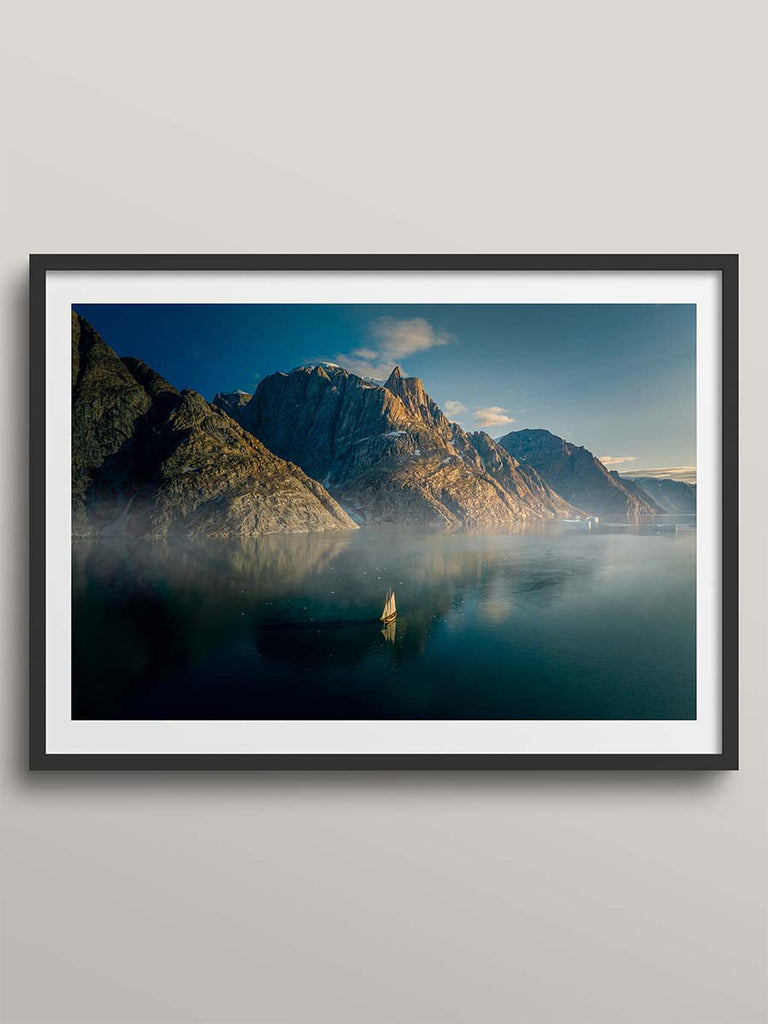
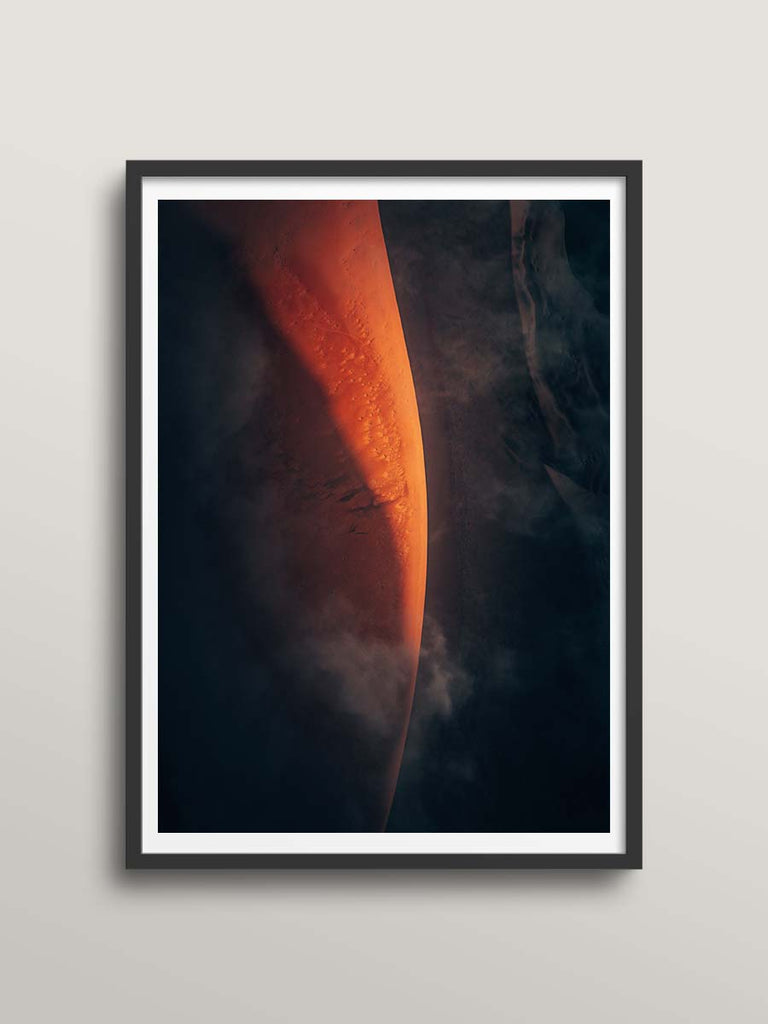
Aerial photography works especially well in small spaces because it carries a sense of distance and scale that close-up or flat imagery cannot. Looking at an aerial print from a small room, the eye travels — across a coastline, down a valley, over a desert. The room does not change. The experience of the room does.
Avoid busy, high-contrast images in very small rooms — they can feel overwhelming at close range. Images with open space, minimal elements and a clear horizon tend to work better.
04
Hang it at eye level.
Not where the wall tells you to.
The standard advice is to hang the centre of the print at eye level — roughly 145–150 cm from the floor. In a small room with low ceilings, going slightly lower (135–140 cm) can make the space feel more intimate and proportional.
Every Airpixels print includes a 50mm white border which naturally adds breathing room between the image and the frame. You do not need additional matting — the border handles it.
05
Choose something
you will live with.
In a small space, the art is always visible. There is no corner to tuck it into, no large room to absorb it. The print you choose will be present every time you are in the room — so it needs to be something that rewards prolonged exposure. Something specific. Something that means something to you.
A print that still holds your attention after two years is worth far more than one that felt right in the moment and became invisible after a month. Buy slower, buy better.
“A print that still holds your attention after two years is worth far more than one that felt right in the moment and became invisible after a month. Buy slower, buy better.”
Airpixels · Stockholm, Sweden
Find the right print for your space
Not sure where to start?
We can help.
If you have a specific wall in mind — its dimensions, the room it is in, the colours around it — reply to any email or use the contact page and we will advise on size, image and placement. Tobias or Maria responds personally.
Every Airpixels print is made to order on 210g natural white art paper with a 50mm white border, printed in Stockholm and shipped worldwide. Free shipping on orders above €95.
Browse all prints Ask for adviceYou might also like
Explore the collection.
The world from above.
Aerial fine art by Tobias Hägg — printed on museum-grade archival paper, made to order in Stockholm.